
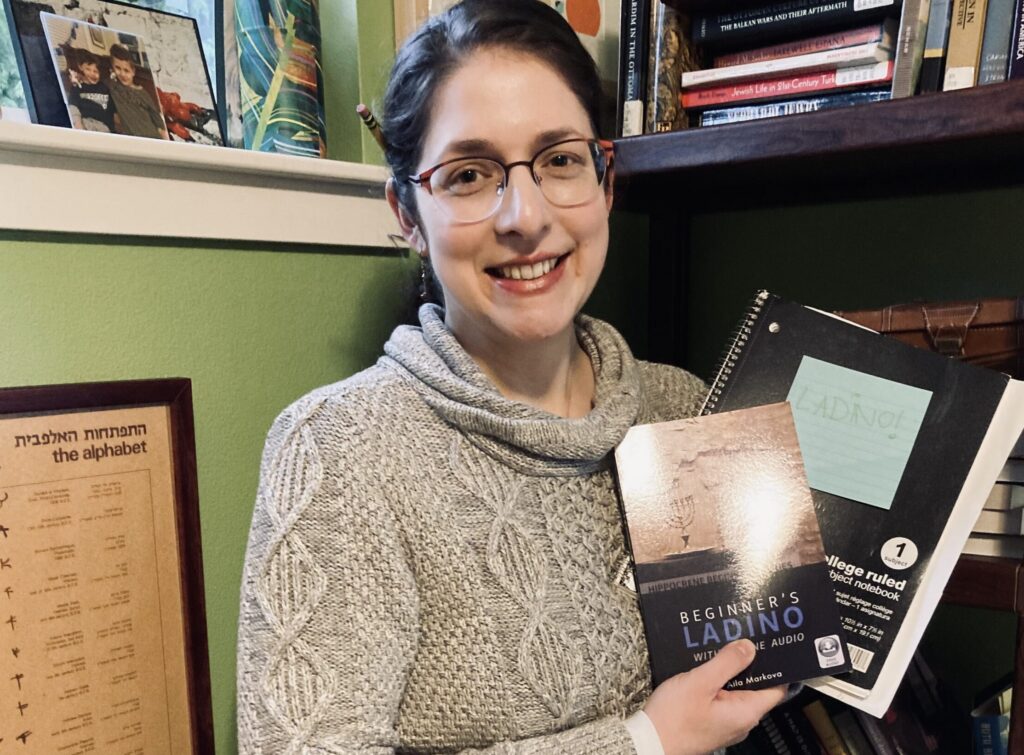
Vengas en buena ora – welcome to my new monthly column! Here I’ll be offering observations about my work in the world of Ladino preservation and Sephardic culture. Join me as I share everything from tips on sourcing evil eye jewelry to deep-dives into Ladino words, encounters with heroes of endangered languages, printed culture, pop culture, and literally anything else that crosses my desk as the ALL co-director and a heritage learner of muestro espanyol.
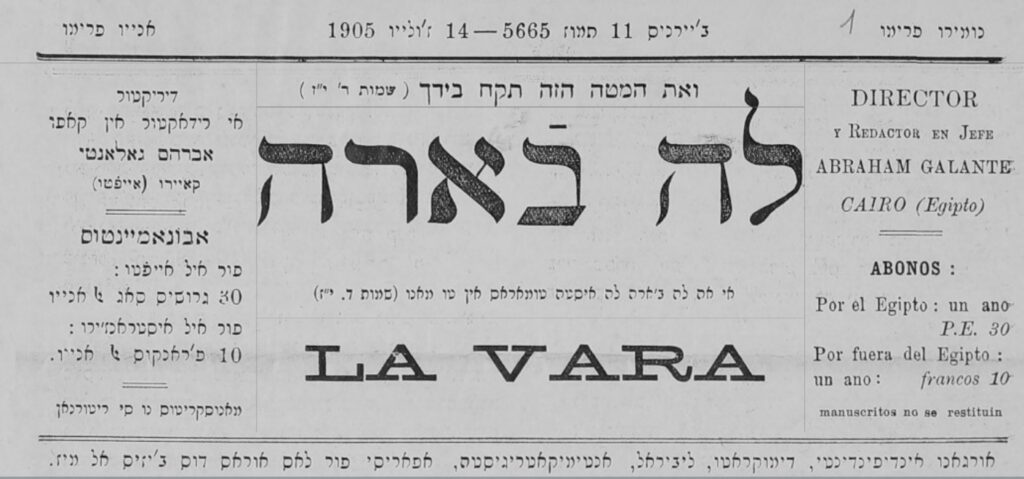
You may be wondering about my column’s title, “La Varika.” My inspiration is actually twofold. La vara is Ladino for “the rod” or “the stick,” and it has been the name of two major publications in Sephardic history. The first “La Vara” was a biweekly newspaper published in Cairo, Egypt, from 1905-1908. The publisher was a Turkish scholar named Abraham Galante (1873-1961), who also happened to be my great-grandfather’s older brother. Galante’s name appears in the masthead from an early issue here:
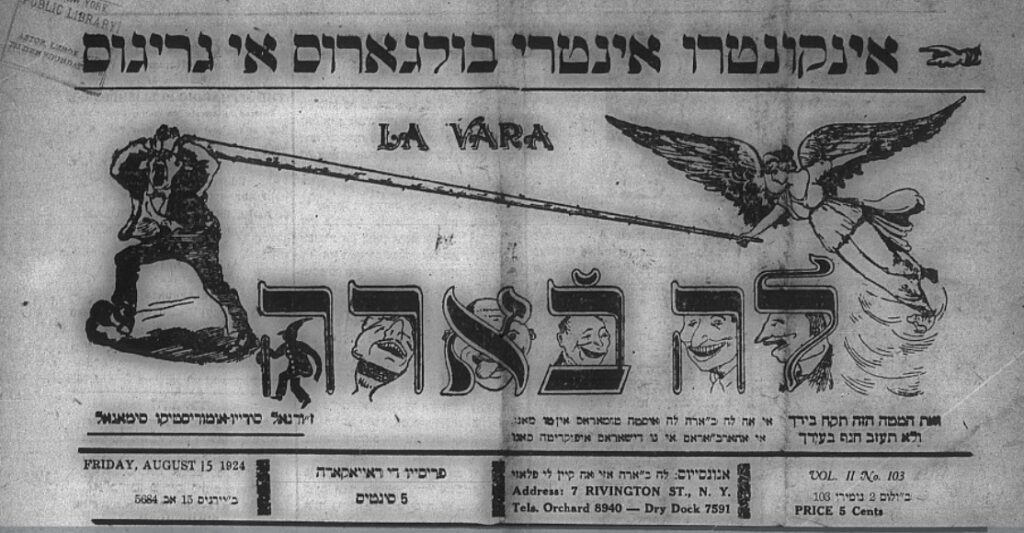
The second “La Vara” was the longest-running Ladino newspaper in America, appearing weekly from 1922-1948. Based in New York, it reached readers around the country. This paper was co-edited by Albert Levy (1896-1963), Moise Soulam (1890-1967), and Albert Torres (1892-1970). Take a look – this masthead has a lot going on!
Both of these publications are now available digitally for anyone curious to see them. You can access the Cairo La Vara here via the National Library of Israel’s website. The American La Vara is available here, also at NLI. What trezoros (treasures)! You could spend hours upon hours flipping through the issues. Something I will be exploring in this column is tension I sometimes feel between the bounty of technological resources at our disposal—archives, genealogical data, and even AI—and the desire to keep a focus on the human voices who make up Sephardic history. I hope, in my writing, to strike a balance between art and archive.
En todo kavzo (in any case), back to why I’ve named my column “La Varika.” If you’ve heard people say things like ijika or hanumika, you’ve heard the diminutive suffix -ika that conveys small size or affection. So this column is la vara + –ika: “the little stick.” What’s the purpose of the little stick? Well, I’m using it to draw a line back to “La Vara” in Egypt that my great-grand-uncle edited, hoping that I will bring some of his intellectual fierceness to this task. Yet I’m also pointing to the American “La Vara,” since this is the community where I am now working for the future of the Ladino language. The -ika of it all reflects how I position myself as a daughter and a student of this culture. I wonder whether my Sephardic identity can be found in Galante’s Ottoman context, in Levy’s American immigrant milieu, or somewhere in between.
Like many of you, I’m learning in real time what it means to be invested in Ladino’s survival. Wherever you may live in the Sephardic diaspora, I hope that you’ll join me in my Ladino wanderings. What will “La Varika” point to next? You’ll need to check back here in September to find out.
Opinions expressed in La Varika are solely those of the author.